My Story with Hanfu: A Cultural Autobiography in Motion
Olivia Yan Huang
My story with Hanfu did not begin with putting on a piece of traditional clothing. It began with a research paper.
In early 2022, I chose to study how overseas Hanfu communities used Weibo to communicate Chinese culture during the COVID-19 pandemic. I spent months reading posts, watching videos, and following the activities organized by Hanfu enthusiasts around the world. Some collaborated across countries to produce an online “Hanfu Spring Festival Gala”; others dressed in traditional Chinese clothing and recorded birthday wishes for China from different parts of the world.
Watching these images from behind a screen, I began to understand more deeply the sentiment captured in an ancient line from The Book of Songs: “How can you say you have no clothes? I will share my robes with you.” (岂曰无衣,与子同袍)
Under the unusual circumstances of the pandemic, Hanfu was no longer simply a reconstructed form of historical dress. It became a way for people separated by geography to recognize one another, sustain a sense of community, and express cultural belonging. These activities also represented a small but vivid form of people-to-people cultural diplomacy. Through clothing, music, ritual, and digital media, participants introduced aspects of Chinese culture to wider audiences while simultaneously reaffirming their own cultural identities.
At that point, however, Hanfu was still something I observed from a distance—a research object that existed primarily in texts, images, and online communities.
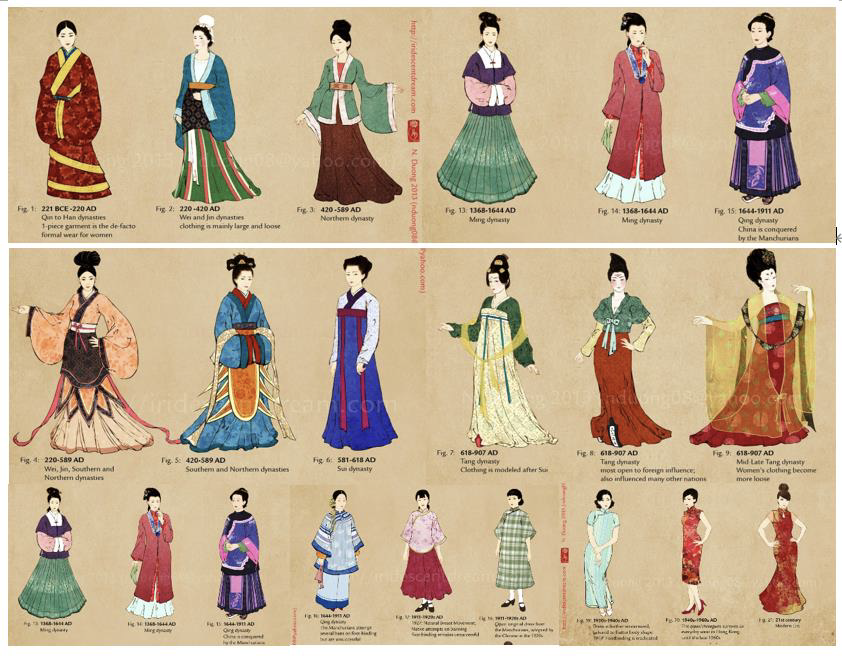
Not long afterward, I unexpectedly stepped into the picture myself.
That same year, I joined a documentary production with Zhejiang International Channel for China Encounters: Chris and His Chinese Partners. Our team traveled to Qingshan Village in Hangzhou to explore the traditional craft of making oil-paper umbrellas, an example of Chinese intangible cultural heritage.
To make the visual connection between the umbrella and traditional Chinese aesthetics more vivid, the director suggested that I wear Hanfu and walk through a bamboo grove carrying an oil-paper umbrella.
It was August in Hangzhou, with temperatures approaching forty degrees Celsius. I wore full makeup, elaborate hair styling, and layers of heavy clothing while filming in the bamboo grove and later at the Liangzhu Museum. It was far less effortless than the final images might suggest. The fabric was heavy, the heat was intense, and there was almost nowhere to escape from the humidity.
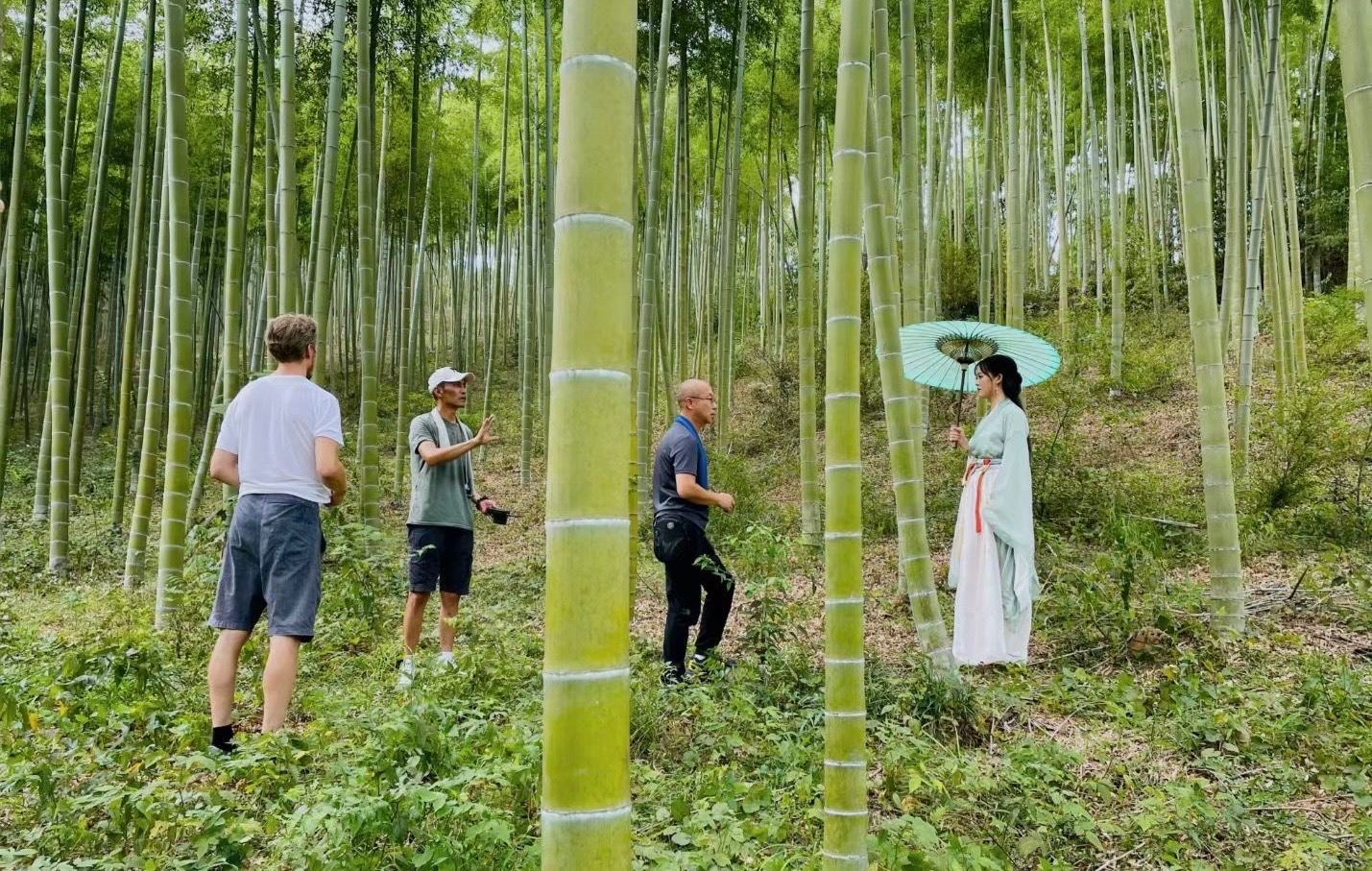
Yet as I walked beneath the bamboo with the umbrella above me, something shifted. A cultural symbol that had previously existed for me primarily in articles, online images, and historical narratives suddenly became embodied.
I was no longer only studying how Hanfu was represented and circulated. I was experiencing how clothing enters a physical space, shapes an image, and participates in the production of cultural meaning.
A few years later, after coming to the United States for my PhD, Hanfu entered my life again in a very different setting.
During teaching assistant training, we were asked to give a five-minute micro-teaching presentation to a small group. The topic could be anything, as long as we could clearly explain a concept within five minutes. I chose to introduce the historical evolution of traditional Chinese clothing and the cultural meanings embedded within it.
Five minutes was hardly enough to cover centuries of clothing traditions. I focused instead on a few details—collars, sleeves, patterns, colors—and explained how traditional dress reflected not only changing aesthetics, but also ideas about social order, ritual, nature, and the relationship between people and the world around them.
Afterward, one of the evaluators, an older Asian woman with silver hair, told me that she found the topic fascinating. She had seen these beautiful clothes in Chinese historical dramas, she said, but hoped that one day she might be able to wear them herself.
I still remember that comment.
It made me realize that cultural exchange does not always require a grand stage. Sometimes it happens in an ordinary classroom, in the brief moment when one person shares something meaningful and another becomes curious enough to want to experience it.
Perhaps that is when cultural communication moves beyond representation: when a culture is no longer merely something to look at, but something another person wants to approach, understand, and encounter.
This March, after attending an academic conference in Philadelphia, I brought a mamianqun—a traditional Chinese horse-face skirt—with me to New York.
I wore it through Times Square and later to the Museum of Modern Art. There was something particularly meaningful to me about walking into a museum of modern art while wearing a garment rooted in another cultural and historical tradition.
I have always liked the idea of such encounters.
Traditional clothing can be understood as a kind of “walking artifact,” but also as living heritage. Once it leaves the display case or the pages of historical texts and returns to everyday life, it is no longer simply a reproduction of the past. It becomes one way in which tradition continues to live in the present.
Walking through the museum in my mamianqun, I felt as though my own body had become a small meeting place between cultures and historical moments. In my imagination, it was almost like arranging an encounter between Confucius and Socrates: different cultural traditions meeting unexpectedly in a modern city like New York.
I was simply the small, moving medium through which that encounter happened.
What made the experience even more striking was encountering Tseng Kwong Chi’s East Meets West series at MoMA. Beginning in 1979, Tseng photographed himself in his iconic Mao suit in front of landmarks such as the Statue of Liberty and sites in Hollywood. Through clothing, bodily presence, and place, his photographs explored how an “Eastern” identity could be performed, viewed, and reinterpreted within Western cultural spaces.
Standing in front of his work, I suddenly felt that my own small impulse—to walk through New York in a mamianqun—had an unexpected resonance with his artistic project.
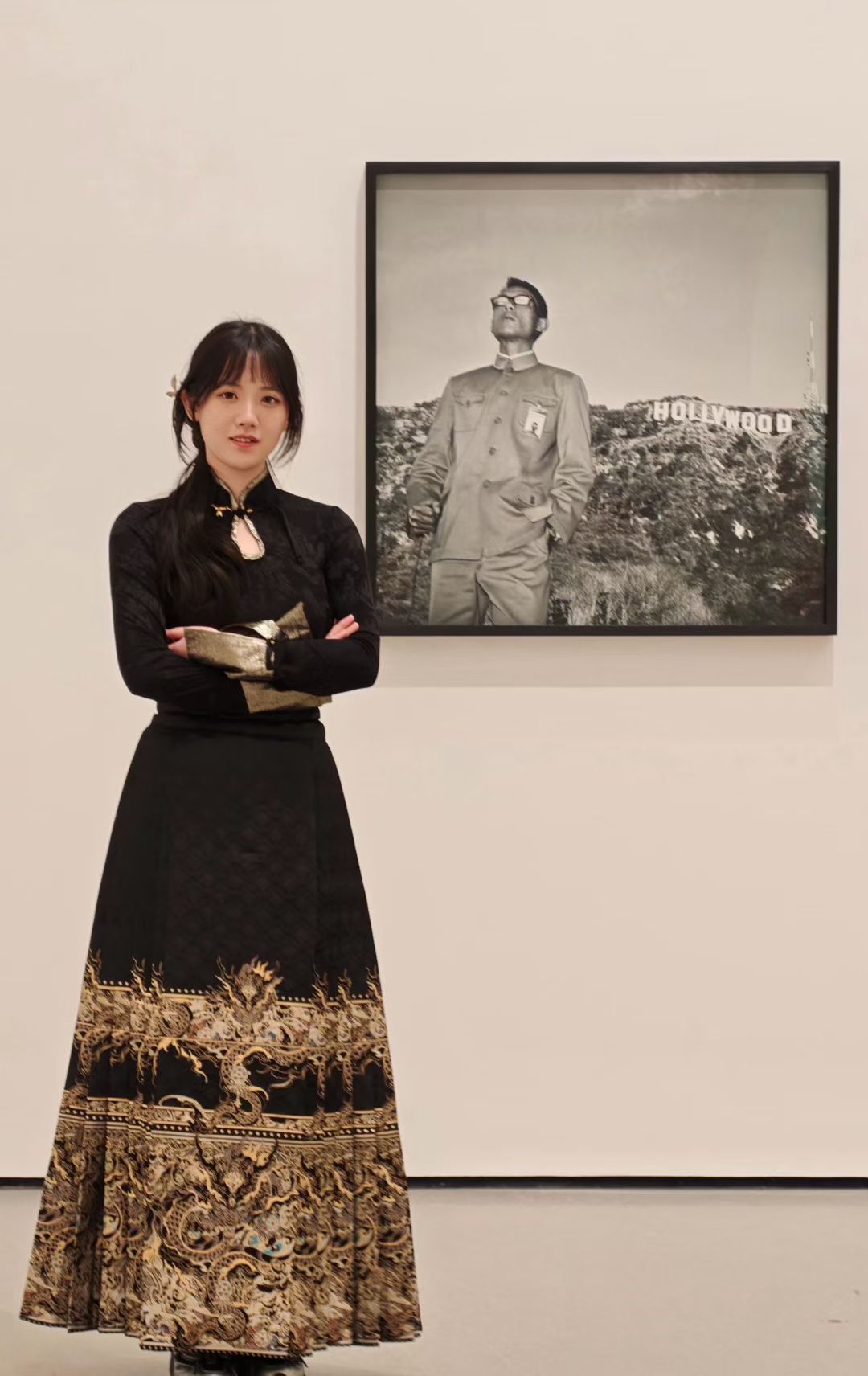
Of course, our historical contexts, identities, intentions, and forms of expression are very different. Yet the encounter made me think about a similar question: What happens when cultural memory travels with the body? When something associated with one cultural tradition enters the physical space of another, how do we understand ourselves, and how are we seen by others?
This summer, I wore my mamianqun again, this time in Chicago. I walked through the University of Chicago’s Institute for the Study of Ancient Cultures Museum, the Fourth Presbyterian Church, the Magnificent Mile, and Chinatown.
Along the way, strangers occasionally stopped to compliment my skirt. When they asked about it, I would explain that it was a form of traditional Chinese clothing.
In China today, Hanfu has become increasingly visible in historical districts, tourist destinations, and everyday cultural life. But when worn far from home, it seems to acquire another layer of meaning.
For someone living abroad, traditional clothing can carry both familiarity and distance. It holds traces of inherited aesthetics while entering spaces its original makers could never have imagined. A mamianqun in a Gothic church, a modern art museum, an American university, or a busy commercial street does not remain culturally unchanged. Its meaning is produced again through each encounter.
This is what I find most compelling about wearing Hanfu abroad.
It is not simply a one-way performance of “Chinese culture” for a Western audience. Nor does it have to represent a fixed, pure, or self-contained version of Chineseness. Instead, it becomes part of a more fluid cultural experience. It carries tradition without rejecting modernity. It expresses identity without necessarily drawing boundaries. It can be looked at, but it also allows the person wearing it to look outward—to encounter, understand, and absorb the cultural worlds around her.
Looking back, I realize that Hanfu has quietly changed roles throughout different stages of my life.
It began as an object of academic inquiry: images on social media and a medium through which overseas communities expressed cultural identity. Then it became a visual element in a documentary, something I wore while participating in the representation of intangible cultural heritage. Later, it entered my classroom as a way of introducing Chinese history and aesthetics to students and colleagues from different backgrounds.
Eventually, it entered my suitcase.
It traveled with me to New York and Chicago, through museums, churches, streets, universities, and crowds.
Somewhere along the way, I moved from being someone who studied the circulation of Hanfu to someone who had become part of its continuing story.
Perhaps this is what makes cultural tradition truly alive.
Tradition is not simply a preserved past sealed safely inside a museum. Nor is it a fixed answer that each generation must reproduce unchanged. It is more like a river: something that carries traces of where it has come from while continually taking new forms as it moves through different bodies, places, and lives.
For me, wearing Hanfu is not an attempt to return to an imagined ancient China. Nor is it only a way of displaying a cultural symbol.
It has become a quiet form of self-recognition.
Wherever I go, I can carry something of where I come from with me. But carrying one's cultural roots does not require closing oneself off from the world. On the contrary, it can offer a point from which to encounter new cities, new art, and other cultural traditions with curiosity and openness.
Clothing wraps around the body, and the body moves through the world.
We carry tradition with us as we travel, but in traveling, we also learn to understand tradition differently.
That, perhaps, is my story with Hanfu: a journey from research to lived experience, from observing to participating, from home to elsewhere, and from elsewhere back toward a new understanding of home.
Hanfu has not taken me back into the past.
Instead, it has accompanied me toward a wider world.
And somewhere in that movement, I have come to understand cultural identity not as remaining fixed within a single definition of who we are, but as knowing where we come from while continuing to discover where we might go.